
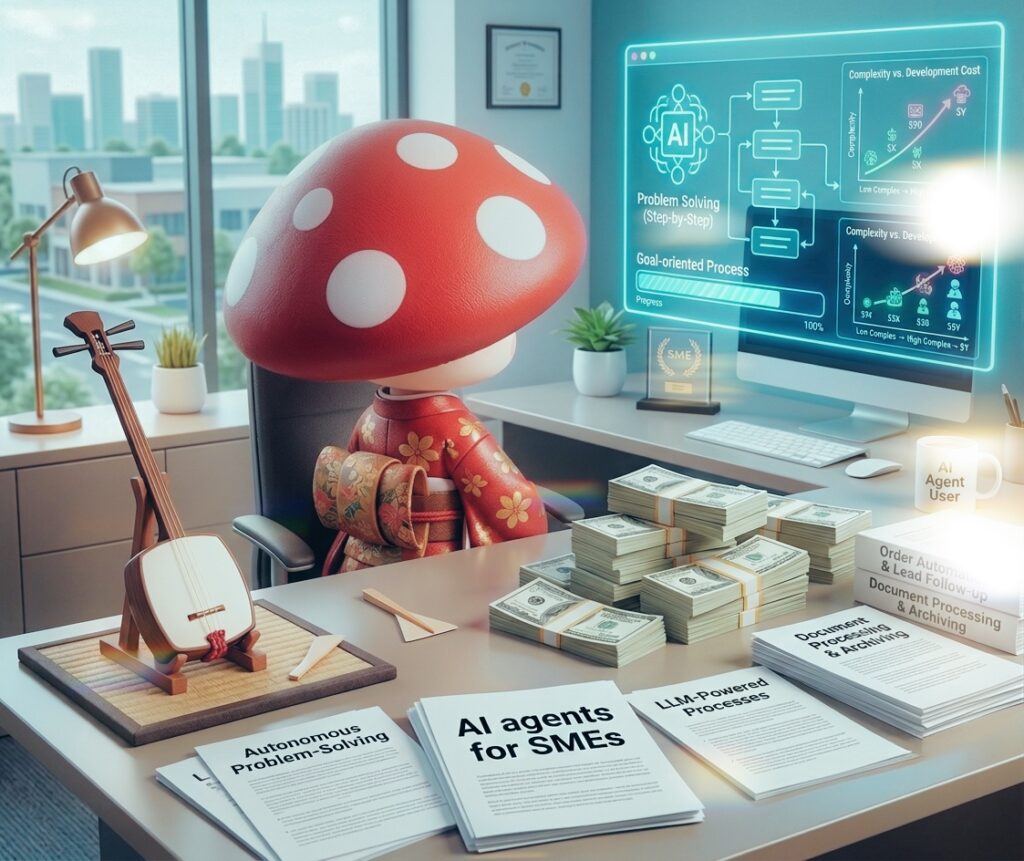
AI Agents for small and medium-sized enterprises are software products using a large language model to autonomously carry out a goal-oriented process by solving problems step-by-step. Traditional Automation technology, on the other hand, works according to predefined rules and cannot solve complex problems. SMEs use AI Agents mainly for customer service and support (e.g., answering frequently asked questions), for automating work processes in relation to customer orders (follow up on leads) and in document management (processing and archiving documents). The cost of developing an AI agent depends on its complexity. Typical costs range from approximately $1,500 to $20,000, depending on scope and integrations (SME-specific benchmarks run closer to the lower end of that range). In addition, there are recurring costs ranging between approximately $50 and $800 per month, with some SME-focused messaging agents priced as low as $29 to $99 a month.
Two years ago, our client had a major problem typical of nearly all SMEs today. Their account team spent roughly three hours creating each new Google Ads campaign based on a client’s briefing. Always the same steps. Always the same spreadsheet. Always copying-and-pasting into Google Ads. Therefore, we created an AI agent that monitors an incoming Google Forms client briefing, passes the data to Claude to create a fully automated campaign template, generates a separate Google Sheet for each client, creates each component of the campaign automatically, and immediately sends the campaign to the client and to the internal teams upon completion. The former three-hour manual task is accomplished by the agent within less than five minutes. We did not improve productivity. We changed how they worked.
It is necessary to be exact in defining an AI agent, since “AI agent” has become one of these generic buzzwords that are used to label every chatbot and Zapier zap released in 2026. An AI agent is fundamentally different from both a chatbot and traditional automation. Whether your SME develops an AI agent during the coming year or delays development until 2027 will have greater significance than many SME owners believe today.
What is an AI agent? What makes it different from other automation technologies you are using today?
Many SMEs already use various types of automation technologies, such as sending automatic emails whenever a form is filled in, or zaps that save attachments directly to Google Drive. These are examples of traditional automation, which operate based on Boolean logic (fixed if/this/then/those rules that always produce the same result). They are quick and inexpensive, but completely incapable of handling anything they were not specifically instructed to expect.
AI automation represents a higher level. It can analyze unstructured input sources such as emails and scanned documents, categorize them, and extract specific details, but the individual still defines every branch and rule prior to the process beginning.
Agentic automation is fundamentally different from the two previous forms rather than simply better. An agentic automation system receives a defined objective (not a list of actions) and then uses fuzzy logic to determine its own approach, adapt to changes in data, and decide what actions it should take next. Rather than having to map every potential customer service scenario ahead of time, the agent considers the client’s subscription level, the type of issue presented, and representative availability, then determines the best-suited representative to respond, without step-by-step guidance from you. This is the core distinction that training material from platforms like Make consistently emphasizes, and it remains the clearest way we’ve found to explain to clients that “automation” and “AI agent” are not synonymous.
| Type | Logic Used | Best For | Limitation |
|---|---|---|---|
| Traditional automation | Boolean logic | Rules-based tasks requiring repetition and definition | Cannot handle surprises |
| AI automation | Boolean + some fuzzy logic | Semi-structured data, classification | Can’t handle every case |
| Agentic automation | Mostly fuzzy logic | Multi-step tasks requiring judgment-based decisions | Requires monitoring, not “set and forget” |
What kinds of AI agents can an SME develop?
This is likely where most articles become ambiguous. As such, we’ll refrain from doing so. Below are the five most common categories of agents we develop for SME clients, and what each one replaces:
Customer support agents who never clock out
An AI agent powered by a large language model fields tier-one customer inquiries continuously throughout the day and night, searching the knowledge base for answers and escalating to a human only when absolutely required. For companies with customers across multiple time zones, this closes the gap between “we will respond tomorrow” and a response at 2am.
Qualification and follow-up agents
Speed to lead is one of the most documented variables in B2B conversion. Harvard Business Review’s audit of 2,241 U.S. companies found that firms contacting a lead within an hour were nearly seven times more likely to qualify it than those who waited even 60 minutes longer, and more than 60 times more likely than firms that waited 24 hours or more. A well-built AI agent reads the inquiry, scores it against your ideal customer profile, sends a personalized first-touch message, and books a discovery call, all before you’ve finished your first cup of coffee.
Contract and document processing agents
Unlike rigid extraction rules built for a single document format, an agent reviews a contract or invoice PDF, checks whether the necessary fields are present, and either approves it or requests the missing information, adapting to variation the way a human reviewer would.
Market and competitive intelligence agents
The agent monitors competitor pricing, new content, and website mentions, and delivers a structured morning briefing to your inbox or WhatsApp, a job that used to require a dedicated analyst or several manually spent hours every week.
Custom multi-step workflow agents
This is the category our Google Ads Campaign Builder example above belongs to: an agent that touches multiple systems (forms, LLMs, spreadsheets, inboxes) and completes an entire process from start to finish, not just one piece of it. If you want a one-line rule for choosing between AI automation and agentic automation: with AI automation, you define the path and AI assists you along it; with agentic automation, you provide the objective and the agent defines the path itself. You can see the full range of agent types we build for SMEs here.
How Much Will an AI Agent Cost Me in 2026?
This is what every SME owner genuinely wants to know, and few vendors have ever given a straight answer. Here’s what the market is actually charging.
Industry-wide, AI agent development costs vary widely by complexity: prototypes generally fall between $10,000 and $30,000, while complex enterprise-grade multi-agent systems can exceed $500,000. But those ranges are dominated by large-enterprise projects. For an SME building a single workflow agent, industry estimates put the reasonable price range at roughly $7,000 to $15,000 per workflow, with smaller, single-task agents available from $5,000 to $30,000.
On the subscription side, AI agent platforms built for SMEs generally offer core capabilities for $50 to $500 a month, with some SME-specific messaging agents priced as low as $29 to $99 a month. Regardless of which route you take, don’t forget the ongoing costs: annual maintenance typically runs 15% to 30% of the initial build cost every year, covering monitoring, API usage, and keeping the agent’s performance aligned as your business evolves. If you’d rather have that conversation with a person than a pricing table, our services page outlines how we scope a build to your budget.
Price table: what different types of agents cost SMEs
| Agent Type | What It Automates | Typical One-Time Build Cost | Typical Monthly Subscription |
|---|---|---|---|
| Customer support / FAQ agent | Tier-one chat on your site or WhatsApp, 24/7 coverage | $1,500 to $8,000 | $50 to $500 |
| Lead qualification and follow-up agent | Scores leads, sends first-touch email, books calendar appointments | $3,000 to $12,000 | $100 to $600 |
| Document / contract processing agent | Reads PDFs, extracts data, flags missing fields | $5,000 to $15,000 | $200 to $800 |
| Market and competitive intelligence agent | Monitors competitor pricing, delivers a daily briefing | $2,000 to $10,000 | $50 to $400 |
| Custom multi-step workflow agent | Connects your CRM, ads, forms, and an LLM into a single flow | $5,000 to $20,000 | $150 to $800 |
| Full multi-agent orchestration | Enterprise-grade system spanning many departments | $60,000 to $150,000+ | $500 to $3,000+ |
Ranges represent estimated industry benchmarks for SME-scale project builds, not fixed quotes. Your actual cost depends on integrations, data readiness, and how much custom logic the agent requires.
Most SMEs reading this table will land on row one or two. There’s no need for anyone to build full multi-agent orchestration for their first project. We’d be lying to you, and honestly committing something close to fuzzy logic malpractice, if we told you otherwise.
What Happens to SMEs That Wait Until 2027?
Here’s where the data gets uncomfortable. Meta’s 2026 report, Beyond Chatbots: The Agentic Economy Is Here, cites Forrester and Gartner research projecting the global economic impact of agentic commerce at $3 trillion to $5 trillion by 2030, and Gartner’s own forecast, cited in that report, states that by 2028, over 60% of enterprise customer service interactions will be managed end to end by agentic AI, up from roughly 20% in 2026. By 2030, Gartner projects 80% of sales and marketing leaders will treat agentic AI integration as a critical competitive factor, up from under 50% in 2026.
The 2026 OECD D4SME Survey puts a number on the anxiety this creates among small business owners directly: half of surveyed SMEs say their business risks falling behind competitors without greater AI use, and that concern jumps to 77% among businesses already using AI, compared to 44% among non-users. In other words, the businesses closest to the technology are the most worried about the gap, not the least.
Separately, Gartner has warned that over 40% of agentic AI projects will be canceled by the end of 2027, largely because companies rush to build the wrong thing, rebrand existing chatbots as “agents,” or skip the groundwork of a clean process map. We think that statistic is actually good news for SMEs reading this article: the businesses that fail are the ones that treat “getting an agent” as the goal instead of “solving a specific bottleneck” as the goal. If you start narrow, with one well-scoped workflow, you avoid the exact failure mode Gartner is describing.
Put plainly: 2027 is not the year AI agents arrive. It’s the year the gap between businesses that started in 2026 and businesses that didn’t becomes visible in the numbers your competitors are reporting to their boards.
What AI Agents Cannot Do (Yet)
Any agency that only tells you the upside isn’t being straight with you, so here is the honest limitation list.
Agents cannot replace judgment on genuinely high-stakes decisions, they can prepare the information, but a human should still approve anything with real financial, legal, or reputational risk. They break when an underlying API or data source changes without notice, which means they need monitoring, not a “set it and forget it” mindset. And an agent is only as good as the process it automates: pointing an agent at a broken workflow just produces broken output faster.
How Do You Start Without Wasting Three Months?
Audit your highest-friction repetitive task first, the one that costs the most time or revenue if delayed, not the flashiest one. Map the entire current process on paper before touching any tool. Match the tool to the complexity: simple trigger-and-action work suits Zapier, multi-branch logic and data transformation suit Make, and custom API work suits n8n. Build the smallest working version first, measure it against your current manual baseline, then add the reasoning layer that turns basic automation into an actual agent.
Frequently Asked Questions
Question: What is the difference between an AI agent and a chatbot?
Answer: A chatbot follows a fixed script or decision tree and can only respond within those boundaries. An AI agent uses a large language model to interpret open-ended requests, make context-dependent decisions, and take multi-step action, such as updating a CRM record or booking a calendar slot, without a human mapping every branch in advance.
Question: How much does an AI agent cost for a small business?
Answer: Most SME-scale agent builds cost between $1,500 and $20,000 depending on complexity, with ongoing monthly costs of $50 to $800 for hosting, API usage, and monitoring. Simple customer support or lead-follow-up agents sit at the lower end, and custom multi-system workflow agents sit at the higher end.
Question: Can a small business build an AI agent without an in-house engineering team?
Answer: Yes. Most SME agents are built on no-code or low-code platforms like Make, n8n, or Zapier connected to an LLM API, which is exactly how Ongito builds client agents like the Google Ads Campaign Builder described above. An agency or freelance automation specialist can typically deliver a first working agent in a matter of weeks, not months.
Question: What happens if my business waits until 2027 to adopt AI agents?
Answer: Based on Gartner’s projections cited in Meta’s 2026 agentic economy report, competitors who adopt agentic AI for customer service and sales workflows now will be operating at meaningfully lower cost and faster response times by 2028, while the OECD’s 2026 SME survey found that half of businesses already fear falling behind competitors on this exact issue.
Question: Which AI agent should an SME build first?
Answer: Start with the process that has the clearest, most repeatable pattern and the highest cost of delay, for most SMEs that is lead response time or customer support coverage. Building a narrow, well-scoped agent first avoids the failure pattern Gartner has flagged in over 40% of canceled agentic AI projects: teams that try to automate an entire department before proving value on one workflow.
Agentic AI is not a future technology SMEs can plan for later. It is infrastructure your competitors, and your customers’ own AI agents, are already building around. The businesses that start with one well-scoped agent this year will be the ones setting the pace by 2027, not scrambling to catch up.
If you’re ready to find out which AI agent would remove the most friction from your business, get in touch with Ongito and let’s build it together.